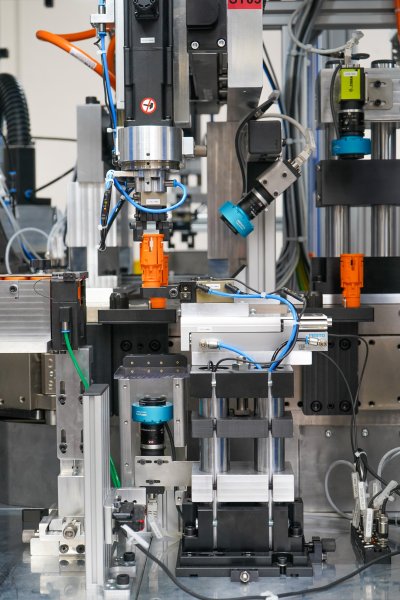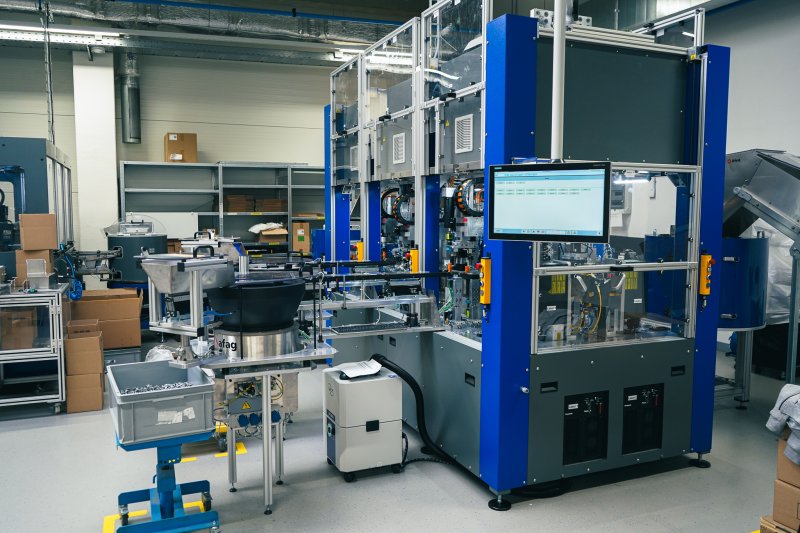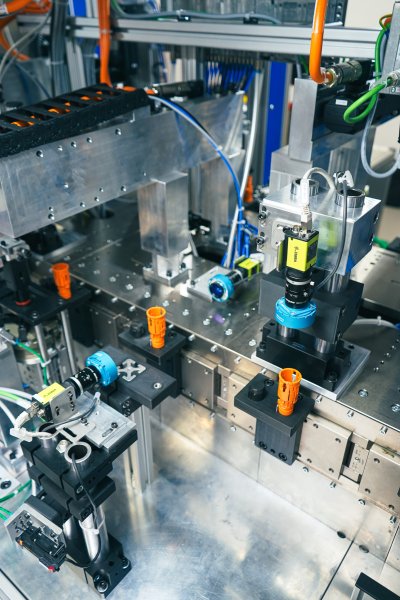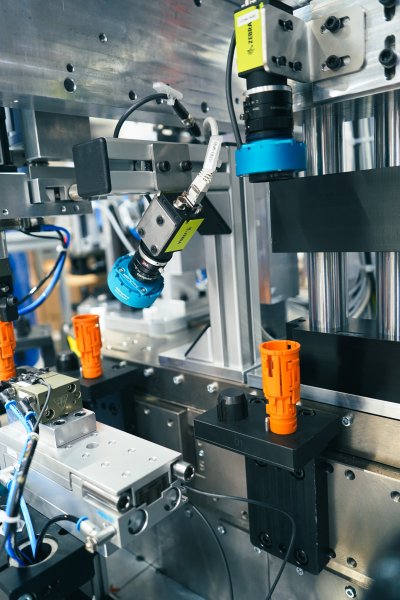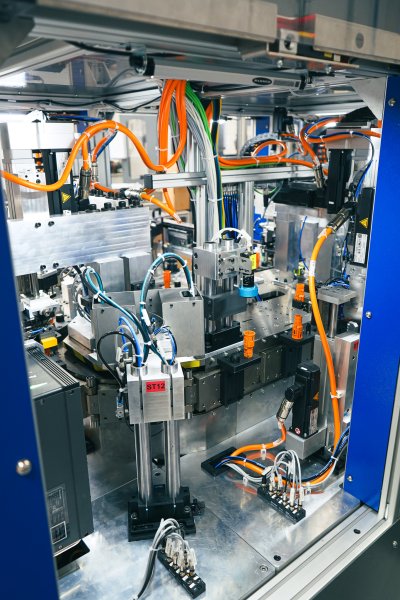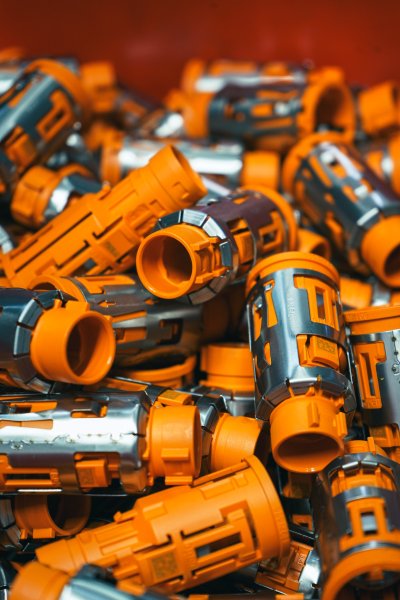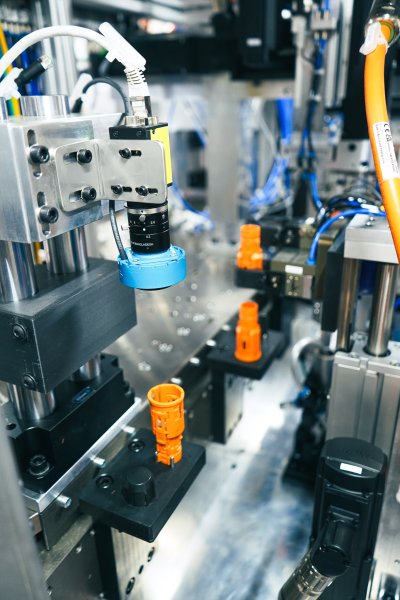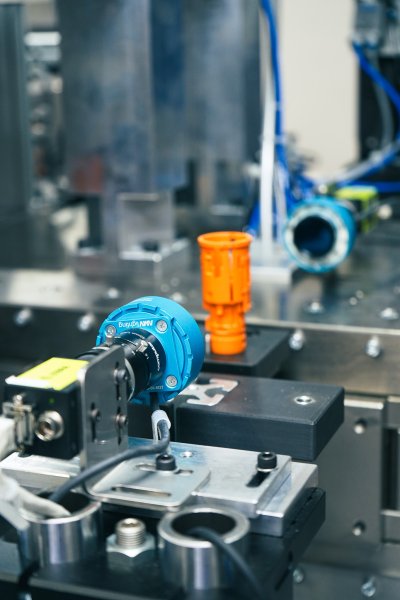
In cooperation with Hirschmann Automotive we implemented a machine vision system for inspection of the PowerStar HPS40-2 connector assembly.The solution is built on proven technologies from our partner Zebra Technologies and forms part of a comprehensive production line, ensuring real-time verification of key assembly steps.
About the Customer and the Partnership
Hirschmann Automotive is a leading supplier of connectivity solutions for the automotive industry, particularly in the field of high-voltage applications.
As a machine vision integrator, AMV Technology was responsible for the design and implementation of vision inspection for selected stages of the assembly process. Our goal was to deliver a solution that would provide reliable performance in a real production environment while being fully integrated into the manufacturing line.
Application Background
High-voltage connectors are critical components within vehicle electrical systems. Every detail of their assembly directly impacts functionality, safety, and long-term reliability.
For this reason, inspection of these components must be systematic, repeatable, and performed without affecting production throughput.
Production Line Structure
The complete production line consists of approximately 20 stations covering the entire process, from part handling to final processing.
The stations perform tasks such as:
- Part handling
- Component assembly
- Product sorting
- Laser marking
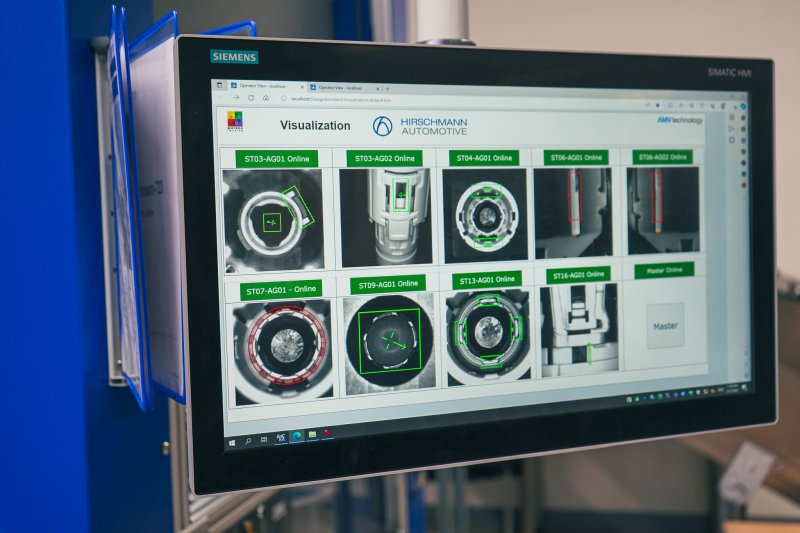
AMV Technology was responsible for the design and integration of 9 inspection stations dedicated to assembly verification.
Solution Design
The solution combines technologies from Zebra Technologies, industrial lighting from the AMV Lighting portfolio, and optical components. The system is fully integrated into the higher-level production line control system.
– Zebra Technologies
The core of the system consists of machine vision hardware and software:
- Software:
1× Aurora Design Assistant (vision application development environment)
- I/O Interface:
1× Indio PCIe card (16 digital I/O channels for communication with surrounding equipment)
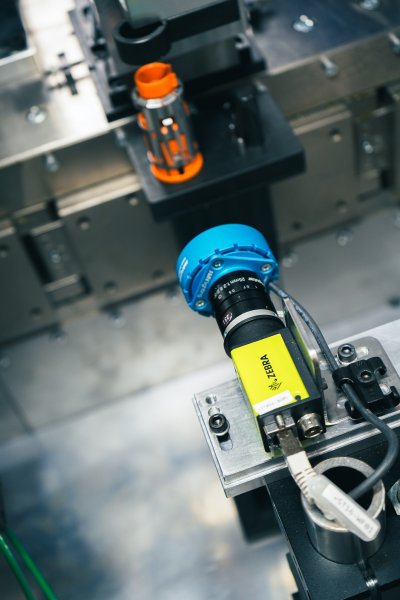
These cameras are distributed across the individual inspection stations and are used to capture critical assembly steps.
– AMV Lighting (Industrial Lighting)
To ensure stable and repeatable inspection results, industrial lighting from the AMV Lighting portfolio was used:
- 9× RING-50-IR850 (infrared ring light)
- 9× lens
- 9× ADPT-RING-50-M27 adapter
The use of infrared illumination improves contrast and minimizes the influence of ambient light, which is essential for reliable detection of fine details.
– Optical Filters
To further optimize image quality, optical filters from MidOpt were incorporated:
- 9×BP850-30.5 IR bandpass filter
These filters allow only a defined wavelength of light to pass through, helping eliminate unwanted environmental influences.
– Integration into Line Control
The entire machine vision system is connected to the higher-level production line control system based on Siemens industrial solutions (IPC, PLC, and HMI).
This integration enables:
- Real-time transmission of inspection results
- Immediate response to detected errors
- Synchronization of individual production steps
– Why Zebra Technologies
Zebra Technologies was selected primarily due to the combination of reliable hardware and a flexible software environment.
Key advantages include:
- Ability to develop a complete application within Aurora Design Assistant
- Stable camera performance in demanding industrial environments
- Easy integration into production equipment
- Unified platform for both development and operation
The CV60 camera series also played a significant role in the system design. The cameras were selected according to the specific requirements of each inspection task.
The combination of 2.3 MP and 5 MP cameras allowed individual inspection stations to be optimized based on the complexity of the inspected features. The cameras provide sufficient resolution for inspection of fine details such as seals and locking components while maintaining the speed required for short production cycle times.
Their industrial-grade design and reliable operation, combined with infrared illumination, make them well suited for continuous operation in a manufacturing environment.
– Overall Architecture
The combination of these components resulted in a system capable of stable image acquisition of even the smallest details while delivering consistent inspection results across all stations.
Inspection Principle
The machine vision system is integrated directly into the production line, allowing inspection to take place continuously during manufacturing. Individual inspection stations are designed to cover key assembly steps from different viewing angles and at different stages of the process.
The inspection includes:
- Connector body orientation
- Verification of the correct part type
- Verification of proper locking tab engagement
- Seal placement inspection from multiple viewpoints (front, rear, and top)
- Verification of ring presence and correct positioning
- Inspection of safety ring orientation and rotation
- Verification of proper CPA element placement
By combining multiple cameras and viewpoints, the system can reliably detect details that would not be visible from a single angle. This approach makes it possible to identify assembly errors at the exact stage where they occur and ensures a high level of quality control.
Results
The implemented solution enables reliable inspection of critical assembly steps without negatively impacting production throughput. The system achieves a cycle time of up to 1.5 seconds per part, while allowing production speed to be adjusted according to current manufacturing requirements. The primary benefit is increased confidence in correct connector assembly and stable, repeatable inspection during every production cycle.
AMV Technology Team