Today, the automotive manufacturing industry faces increasing model variability, pressure to maintain quality, demands for parts traceability, and the rise of electromobility. Every vehicle consists of thousands of components, and any error in inspection, assembly, or identification can result in delays, rework, or costly warranty claims.
This is where machine vision plays a crucial role. It helps automate visual inspections, read codes, verify assembly accuracy, measure dimensions, inspect surfaces, and track parts throughout production. It’s not just about speed. What matters is repeatability, objective evaluation, and the ability to integrate with production data.
As a machine vision integrator, we collaborate with our partner, Zebra Technologies, whose portfolio offers a wide range of options for automotive applications. These include fixed industrial scanners, smart cameras, 3D sensors, and image processing software.
Quality control can no longer wait until the end of the line
In automotive manufacturing, the goal is to detect problems as early as possible. The later a defect is discovered, the more expensive it is to fix. That is why machine vision is deployed at various stages of production—from inspecting individual parts through assembly operations to the final inspection of the finished vehicle.
Typically, it assists with the following tasks:
- checking for the presence and correct positioning of parts,
- reading 1D and 2D codes,
- measuring dimensions and geometry,
- detecting surface defects,
- inspecting welds, adhesives, and sealant beads,
- guiding robots during assembly,
- verifying correct configuration according to the production plan.
This makes it possible to automate tasks that are repetitive for humans, difficult to evaluate, or require consistent precision.
Zebra Technologies' Portfolio for Automotive Applications
Zebra Technologies offers technologies for a range of application requirements, from simple barcode reading to complex 2D and 3D inspections. The most common solutions for automotive applications include:
- FS Fixed Industrial Scanners: For automatic reading of 1D and 2D codes, tracking parts, components, packaging, and entire assemblies. They help create a digital trail throughout the manufacturing process.
- VS / Iris GTX smart cameras and sensors: For presence checks, proper assembly verification, code reading, defect detection, and simpler measurement tasks. The advantage is a compact solution that combines imaging, image processing, and evaluation.
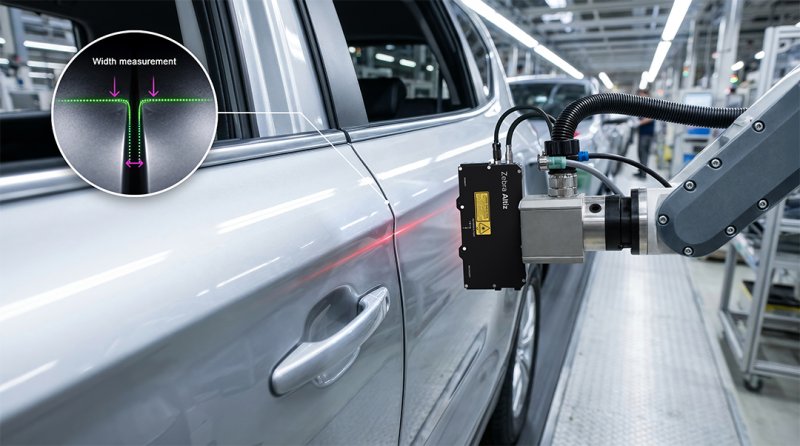
- AltiZ, AltiZ 4200, and 3S Series 3D Sensors: For applications where a 2D image is insufficient. Typically for measuring height, profile, volume, flatness, gaps, and alignment, or for inspecting complex surfaces.
- Zebra Aurora Software: For the design, configuration, and management of machine vision applications. Depending on the task, you can use classic algorithms, measurement tools, OCR, barcode reading, and deep learning.
Where is machine vision used in the automotive industry?
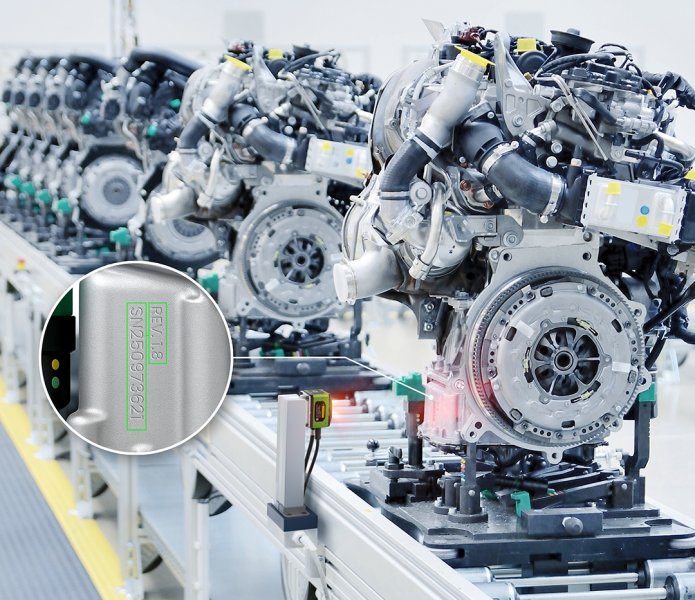
Powertrain: from castings to engine assembly. Powertrain manufacturing requires a series of precise inspections. Even at the casting stage, it is necessary to check for pores, cracks, burrs, and missing or excess material. After machining, surfaces, holes, threads, mating surfaces, and dimensional tolerances are inspected.
Typical parts for inspection include, for example:
- engine blocks,
- cylinder heads,
- gearboxes,
- valve bodies,
- brake discs,
- gears, and other machined parts.
For these applications, a combination of high resolution, properly designed industrial lighting, 2D cameras, 3D scanning, and software for measurement and defect evaluation may be appropriate. Traceability is also an important component. Code reading allows for tracking the part’s history, its path through production, and correct assignment to the assembly operation.
Electromobility: Batteries, Motors, and Electronics
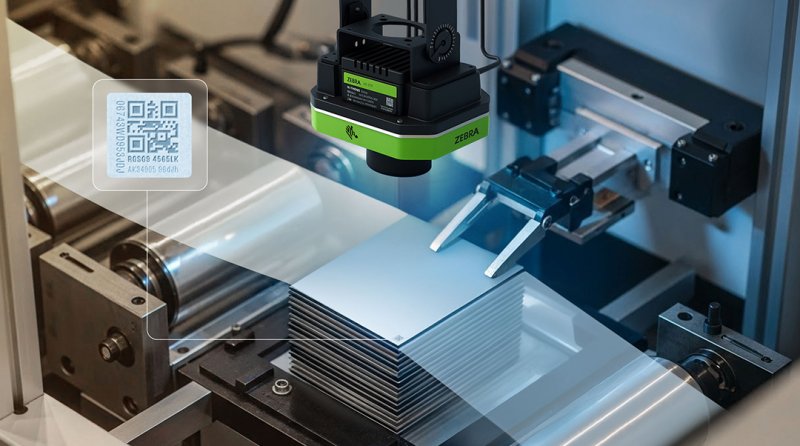
As electromobility advances, the importance of inspections in the areas of batteries, electric motors, and electronic modules is growing. In battery production, precision in assembly, cleanliness, proper component placement, surface inspection, and dimensional stability are critical.
Machine vision is used here, for example, for:
- inspection of electrode layers,
- verification of cell alignment,
- detecting foreign objects,
- inspecting connectors,
- inspecting adhesive or sealing strips,
- reading codes for tracking battery components,
- inspecting motor parts, welds, and wires.
For cable harnesses and electronic control modules, it helps verify correct wiring, the presence of connectors, wire colors, soldering quality, and board mounting. This often combines color 2D imaging, high resolution, 3D metrology, and in some cases, deep learning.
Body and Frame: Welds, Stamped Parts, Nuts, and Pins
Body manufacturing is an ideal application for machine vision, but it also presents a number of challenges. It involves large parts, complex shapes, reflections, variable surfaces, and a large number of inspection points.
Machine vision helps inspect:
- stamped parts,
- holes and cutouts,
- cracks and deformations,
- welds,
- welded nuts and pins,
- the position of components relative to reference points.
For welds, it is necessary to monitor their presence, shape, continuity, and possible defects. For welded nuts and pins, correct position, orientation, and completeness are important. Depending on the specific application, 2D cameras, smart cameras, 3D sensors, or robotically guided imaging systems can be used.
Body-in-white: adhesives, seals, gaps, and fit
During the body-in-white phase—that is, after the basic body parts have been joined and before painting—adhesives, sealing materials, sound-deadening elements, body panel joints, and the assembly’s geometry are inspected.
For adhesive and sealant beads, the following are monitored in particular:
- presence,
- width,
- height,
- continuity,
- discontinuities,
- bubbles or voids,
- position relative to an edge or reference element.
Where height or volume needs to be measured, 3D scanning is often appropriate. For simpler checks of presence and position, a properly designed 2D application may suffice.
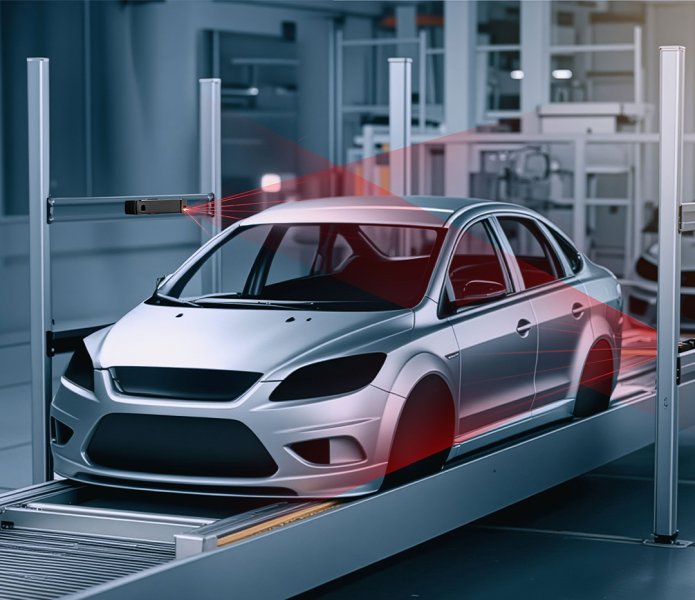
Another important area is gap & flush measurement, i.e., gaps and alignment between body parts. This inspection affects the functionality, appearance, and overall perception of the vehicle’s quality. 3D profilers enable non-contact measurement of gap width and height differences between adjacent surfaces.
Final Assembly: The Right Part in the Right Place
In final assembly, automation meets manual labor. Each vehicle may have a different configuration, so it is important to verify that the correct part is installed in the correct position.
Machine vision helps, for example, with the inspection of:
- prepared sets of parts,
- the installation of headlights, door handles, and emblems,
- the positioning of the windshield or rear window,
- adhesive application,
- the installation of wheels and tires,
- interior components,
- and the correct positioning of logos and model designations.
For windshields and rear windows, machine vision can be part of robotic guidance. A camera or 3D sensor helps determine the part’s position, check adhesive application, and verify final placement.
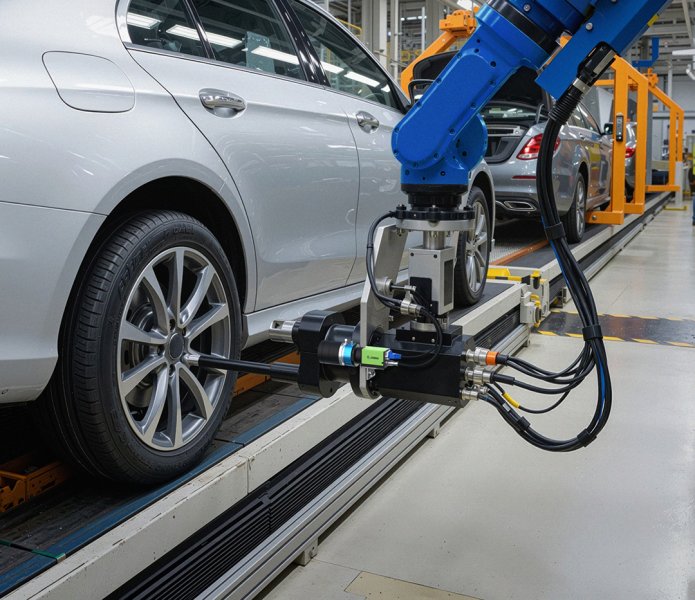
For wheels and tires, correct identification according to the production plan is key. This is achieved through code reading, OCR, or more advanced tire surface scanning, where the low contrast of black markings on black material requires the selection of an appropriate scanning technology.
Traceability, Deep Learning, and Proper Integration
Automotive manufacturing relies on traceability. Every part, assembly, and finished vehicle must be properly identifiable. Reading 1D and 2D barcodes, direct part marking, VIN codes, and OCR are therefore key areas of machine vision. Deep learning can help with hard-to-read characters, low contrast, damaged markings, or variable defects. However, the technology alone is not enough. The outcome depends on the entire application design—that is, the optics, industrial lighting, mechanical mounting, communication with the production line, evaluation software, testing on real parts, and subsequent integration into operation.
At AMV Technology, we view machine vision as a holistic system. We don’t just focus on component selection; we also ensure that the proposed solution is stable, serviceable, and suitable for real-world production conditions.
Do you want to automate inspection in automotive manufacturing?
Machine vision in the automotive industry is not just about finding defects. It is a way to gain greater control over production, speed up processes, reduce the risk of errors, and support the traceability of every part. We would be happy to review your specific application with you, verify the technical possibilities, and propose a suitable machine vision solution for your operations.
AMV team